
Sixty-Five review on Progwereld
This is a translation of Dick van der Heijde’s review published on Progwereld.
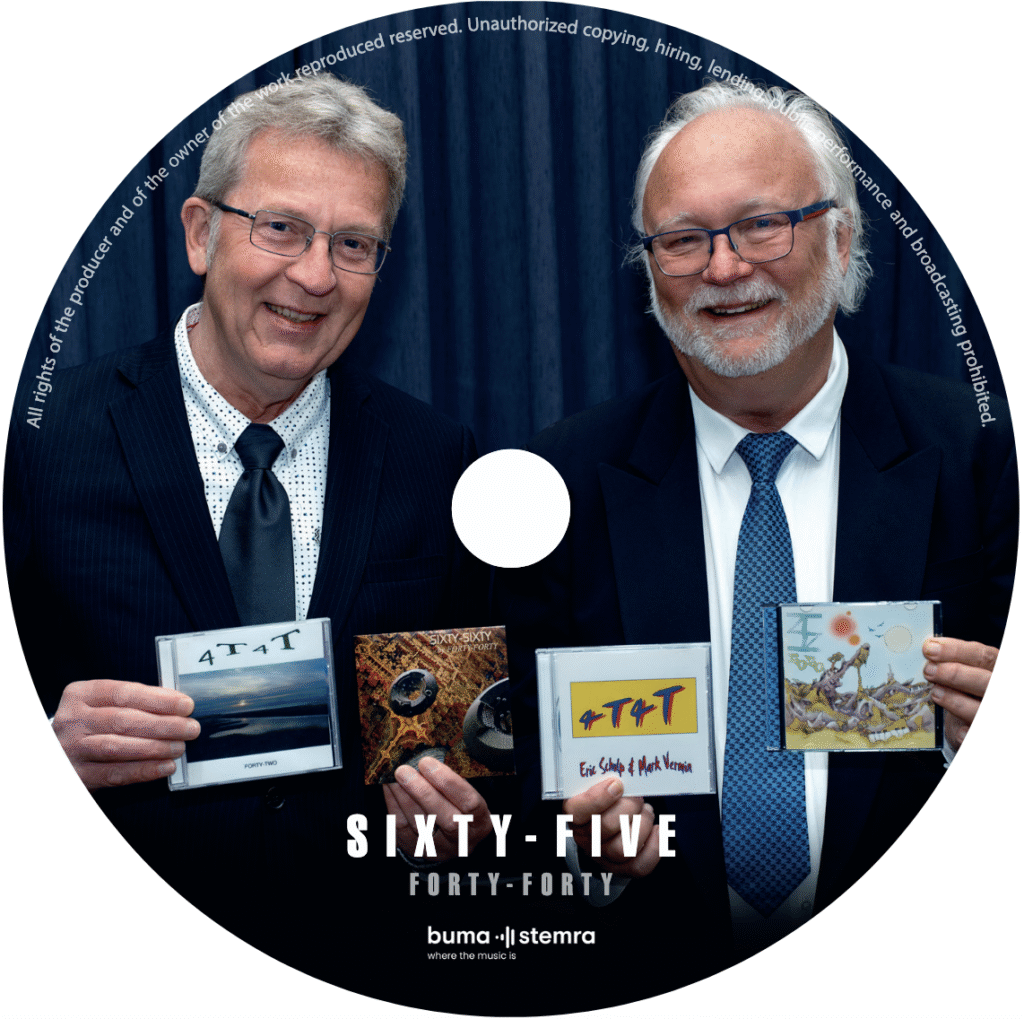
Forty-Forty is a project by two childhood friends from The Hague: Eric Schulp (keyboards) and Mark Vermin (guitar). Years ago, they decided to celebrate their fortieth birthday by making an album. In my review of its follow-up, Forty-Two, I was enthusiastic about their 70s-style prog, though I did criticize its dynamics. Now their fifth creation, Sixty-Five, has been released, and once again it’s up to me to share my thoughts. Well – gladly.
The album completely immerses me in virtuosic retro-prog in the vein of Camel, Renaissance, and especially Rick Wakeman, while also tastefully incorporating elements of jazz, classical music, film scores, and even a touch of metal. Everything sounds much more mature, and the overall production is deeper and richer. Sixty-Five has become a welcome regular in my CD player.
The album is largely instrumental; only three out of the eleven tracks feature vocals. Because each of these songs is sung by a different female vocalist with a similar vocal tone, the album maintains a good flow. If I had to describe the music in a single word, “majestic” would probably come closest. Naturally, there are plenty of tempo and mood changes to keep you engaged. Technical skill abounds here.
Diversity opens the album in a typical way. It begins somewhat New Age-like and evolves into an excellent prog track filled with deep bass lines, stately guitar arpeggios, elegant keyboard melodies, and cutting guitar work. It sets the stage perfectly for what’s to come. The following track, Revelations, kicks off with force but quickly settles into wonderfully melodic prog waters. Outstanding drumming by Elvin den Haan guides you through the measures. The track also treats you to dreamy keyboard chords, spacey vocals, and a wild keyboard solo that would make Wakeman proud.
As mentioned, Schulp and Vermin also made sure to add stylistic variety. On Connect, Eternal Friendship, and New World, we hear various blends of jazz and pop. I should note that the female vocalists thankfully steer clear of scale-acrobatics. A real highlight is the two-part suite Steve’s Shadow. The first part leans into classical and cinematic sounds, while the second focuses on slow, sweeping symphonic rock.
With the tracks Flashbacks, Deferred Desire, and Ups And Downs, the band returns to its own signature style. These are solid contributions, but the final track, Symphonic Journey, is so much better that they end up competing with themselves. What a phenomenal piece. I’m not even going to try to describe it—you’ll find it on our Spotify playlist. Then you can hear for yourself that the bombast is truly next-level.
Finally, I’d like to emphasize that Schulp and Vermin don’t make music for profit. All of their albums are available on Spotify. Their joy is your joy.
Sixty-Five review in IO-Pages
This is a translation of René Yedema’s review published in iO-Pages, magazine for progressive rock music, in December 2025. The original Dutch text can be found HERE.
Contemporaries Eric Schulp (keyboards) and Mark Vermin (guitars) have known each other for 55 years. Although they played in bands like EYE beforehand, it wasn’t until they were forty that they decided to record an album featuring the music they love: symphonic rock rooted in the seventies. They called their project and their self-released debut CD, “Forty-Forty” (or “4T-4T”), in 2000. The two got a taste for it and began working with guest musicians, including EYE drummer Ronald van der Zant. They’re now on album number 5, “Sixty-Five, another authentic progressive rock album recorded in their home studio. The beauty of this hour-long nostalgic trip is that it rarely overtly copies musical ideas from their idols. For example, while “Steve’s Shadow Part 2”, introduced by the neo-classical music breathing “Part 1”, features a structure and instrumentation that reference Steve Hackett’s epic “Shadow Of The Hierophant”, the melodies seem more like a reflection of the original. Furthermore, the complex, 11-minute closing track, “Symphonic Journey”, contains references to Yes, but those stately piano strokes, characteristic church organ breaks, and Wakemanesque Moog solos simply fit perfectly with their own creation. “Sixty-Five” has a largely instrumental, Finch-esque flow, interrupted three times by songs performed by an equal number of female vocalists. Of these, the relaxed “Eternal Friendship” has a jazzy/bluesy touch thanks to the smooth saxophone contributions. The orchestrations from the keyboards sound quite true to life, aside from some thin piano parts, the organ growls adequately, and the guitar work alternates between melodically drawn-out and robustly riffing. With a final remark on the varied drumming and the brutally humming synthesizer basses, we can conclude that 4T-4T has an excellent feel for the genre.
The album is available for free listening via various streaming services.